
Trump Signals Policy Shift on Artificial Intelligence, Entertaining Guardrails to Manage Emergent Risks
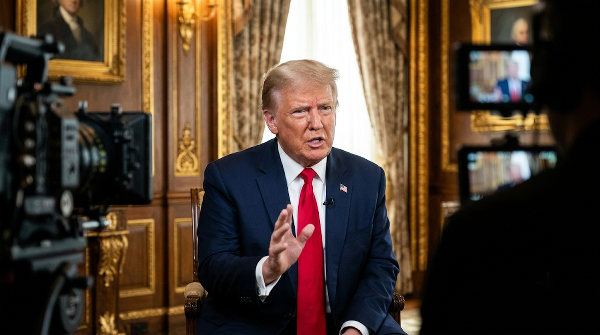
President Donald Trump has indicated a marked shift in his administration’s approach to artificial intelligence, telling CBS’s “60 Minutes” that the escalating risks associated with the technology are manageable while signaling a newfound openness to federal guardrails. During the November 8 broadcast, the president departed from his previously hardline deregulatory stance, acknowledging that while rapid AI proliferation presents distinct challenges, these hazards do not require halting development. Instead, his remarks suggest a pragmatic pivot toward establishing baseline protective measures. For an administration that has historically championed aggressive deregulation and insisted that technology conglomerates self-police, this rhetorical evolution introduces a critical new variable into the debate over how the United States will govern generative AI.
Investing.com
- 2
The underlying mechanics of this policy adjustment are deeply rooted in the geopolitical contest for technological supremacy, particularly the competition with China. Previously, Trump explicitly dismissed the necessity for comprehensive regulatory frameworks, arguing in September that governmental interference would solely benefit Beijing’s unencumbered tech sector. However, the administration’s revised posture embraces a calculated compromise: implementing targeted, light-touch safeguards without throttling innovation. This strategic recalibration reflects an understanding that unmitigated AI deployment—ranging from sophisticated deepfakes to algorithmic vulnerabilities—poses domestic threats that free-market forces alone cannot resolve. The challenge lies in engineering regulations that secure public trust without ceding the competitive edge in machine learning to foreign adversaries.
Crypto Briefing
- 2
An in-depth analysis of the proposed shift reveals a delicate balancing act involving legislative compromises and industry stakeholder dynamics. Trump notably expressed a willingness to collaborate with Democrats to formulate these safety measures, provided such legislation explicitly prioritizes maintaining America’s developmental lead. This bipartisan olive branch, arriving immediately after the 2026 midterm elections, suggests that AI governance may transcend typical partisan gridlock. Primary stakeholders are now confronting a landscape where federal intervention is a probable reality. The administration’s focus will likely center on quantifiable metrics, demanding transparency in training data and establishing clear accountability protocols for systemic failures, all while avoiding the heavy-handed mandates characteristic of international frameworks.
Crypto Briefing
The real-world ramifications of this developing framework will fundamentally alter how artificial intelligence is commercialized and integrated into everyday American life. For the private sector, standardized guardrails could provide a stable operating environment, mitigating the uncertainty of navigating a fragmented patchwork of state-level laws. Industries reliant on automated decision-making—including finance, healthcare, and human resources—must recalibrate their compliance strategies to align with these anticipated federal baselines. Furthermore, this policy shift validates the necessity of safeguards, taking a definitive step toward addressing public anxieties surrounding data privacy and algorithmic discrimination. Practical implementation will require immense regulatory agility to ensure that rules keep pace with models that evolve almost exponentially.
Looking forward, the administration’s openness to regulation sets the stage for a contested legislative drafting process. Expert consensus suggests that while endorsing guardrails is a necessary preliminary step, the efficacy of any future framework depends on its enforcement mechanisms and technical thresholds. Lawmakers must transition from theoretical agreements to drafting granular, technically sound policies that withstand industry lobbying. The decisive takeaway is that the era of absolute self-regulation in the American AI sector is drawing to a close. As the United States seeks to cement its leadership in the global technology race, it is formally recognizing that true dominance requires robust institutional wisdom to govern it responsibly.